Wednesday, May 18, 2022

{Uber} union {Ola}. Who is the smartest of all?

During a recent visit to Bangalore in Karnataka, India which I was visiting for a day after several years I took the app based taxi ride. In India the major players are Uber and Ola. While they have their share of customer dissatisfaction (cancelled rides, driver misbehavior, high peak charges and tonnes of other thing), what struck me was to ask a question as to 

who are  the smartest  people who are part of this app based taxi infrastructure

 As you would have guessed, it was prompted by an incident.

While I have made no attempts to look up the people structure of either  of these two app based taxi companies, the hand sketch grossly captures the structure, 

  • the cone makes up for all the people (managers, market researcher, developers - both software and algorithm, ...) who work for these companies, CEO included! and 
  • the square that is primarily the people who drive these taxi
It is fair to assume that the cone is made up of specialized people (Enginers, MBA, Researchers, etc) who come from specialized institutions (IIT, IIM, ...) and the square is made up of people, majority of whom might not have come from specialized institutions.
 
Gross simplification of the people who work (directly or indirectly) for Uber and Ola

What is important is to note that these two companies, offering the same service rarely share anything, they have separate infrastructure, they use their own AI based algorithms to match the rider to the ride and the driver to the customer and compute the fare etc. As expected these are two different companies! Except ofcourse the drivers who drive for both these companies {in terms of using the app!}

However, if not all the drivers, a significant set of drives with the switch of an application can become an Ola driver or a Uber driver (represented by the intersection of the squares!).

The incident

I book an Ola to go to the airport, instead of asking for the OTP, the driver asks me 

"How much are you being charged?"

I say," INR 1335" hesitantly. 

"Sir can you cancel the ride?", He asks. 

I ask him "Why?"

He says, "Ola will give me approximately INR 600 for this ride, if you cancel it, they will charge you INR 35 as the cancellation charges, I can take you to the airport for INR 1300 (all in my pocket). You do not loose anything, a poor fellow like me gains a lot"

I am stunned. 

I say "Isn't it unfair? You got this opportunity of this ride because of Ola platform and now you are being dishonest."

He gives me a "You are a Gandhi" look. 

I reluctantly agree only out of fear that he might cancel the ride and I will be left with no taxi to reach the airport in time. 

After a few minutes into the ride, he switches of his Ola App. I figured out that he did not want Ola to know that he was taking me to the airport. 

Now comes the smarter part.

And after almost 1 hour we are closing in on to the Bangalore airport, this is when he displays his mastery, he switches on the Uber app and lo he becomes a Uber driver, ready to take someone else from Bangalore airport to their home.

The smartest (in what ever sense) in the whole chain are the drivers that ride both Ola and the Uber. They make use of the infrastructure of both Ola and Uber smartly (can not say it is fair) to take maximum earnings. 

Unless the Uber and Ola infrastructure talk to each other, there is no way either of them will find these smart drivers using their platforms without paying for it.

Advantage square. Specialized people in cone need to catchup!

Monday, May 09, 2022

Why is Speech Signal Processing more complex than Text Processing


At best a speech signal can be best described as 

 indiaisthelargestdemocracywelcometoindia

 and in reality it is 

either 

indiaesthelarzestdemocracyvelcometwondia  or indiaes thelarzestdemo cracyvel cometw ondia

Those of you who have paid attention to the 40 character signal would be able to see that it is actually

India is the largest democracy. Welcome to India.

This essentially is the difference between the input's seen in a text processing pipeline versus a speech processing pipeline. For this reason several ask to the speech processing community is (Speech Recognition)

Can you give us "India is the largest democracy. Welcome to India." from the speech signal "indiaes thelarzestdemo cracyvel cometw ondia"? 

so that we can go on with out text processing pipeline and do all the glittery stuff in Natural Language Processing. 

A speech processing researcher is looking at  "indiaes thelarzestdemo cracyvel cometw ondia" or "indiaesthelarzestdemocracyvelcometwondia"  while a text processing researcher is looking at "India is the largest democracy. Welcome to India."

The differences "capitalized alphabets, the punctuation's, the word separators, ..." are a boon, served on a silver plate, to a text processing engineer. While they are to be deciphered, with significant effort, from a speech signal for a speech engineer.

As an example, just imagine how easy it is to identify the number of times "India" occurs in  a text signal versus trying to identify "India" in the speech signal "indiaes thelarzestdemo cracyvel cometw ondia" (Keyword spotting).

But a speech signal come with a lot more information than just the linguistic content. It has information about the speaker gender (male, female), speaker age (adult, child), speaker identity (Sunil, ...), speaker state (happy, neutral, stressed, ....), speaker accent (Indian, Australian, ...), speaker dialect, speaker health (dysarthric, ...) ... which most often does not accompany the text signal "India is the largest democracy. Welcome to India." 

However for any transaction to happen between a machine and a human the crucial step is one of trying to get the linguistic content in the speech. For example, a robot in an airport trying to answer questions posed by the travelers requires the robot to convert speech into text perfectly. And for this reason the priority and focus, in the speech community, has been on exploiting only the linguistic content in the speech signal (Speech Recognition) and not so much on any other information that is abundantly and uniquely present only in the speech signal.

A robot that tries to answer information about Bangalore airport in India. The first part is the ability to understand what the human is "asking", namely to convert speech signal into text.
 

For this reason it is natural that concepts and algorithms that pass the test or performance on text strings (signal) are adopted (given a try!) in speech signal processing.

For those of who who are curious. For a visual feel as to why speech signal is complex, please see complexity of speech.


Wednesday, March 16, 2022

When Death Comes Knocking Home

I am sure 99% of the people would not step into such a blog title; this is natural because we are conditioned like that since our birth. We always equate birth to "happy" and death to "sad" knowing very well that being mortal means a death always comes with a birth. 

Unlike birthday which occurs every year after a birth and gets celebrated most often, we get some sort of experience in organizing a birthday event. We know the exact date, giving us ample time to plan (inviting people, making arrangements, planning venue, planning food) the birthday and added to this you could go onto any e-commerce site and order the arrangements. 

Everything is comfortably done, for a birthday, because the date and time is known prior. However death in a family come knocking suddenly and without any prior appointment which makes planning ahead of time impossible. Added to that in a big city most of us are unaware what to do and then there is a limited time frame to do the needful. 

When death came knocking in our home recently, like it happens to most of us it was sudden and I was unaware as to what all to do and more importantly how to go about it. What are the rituals that need to be done. How and where is the body is to be cremated. What are the municipality formalities. 

This is an account of my experience. In Mumbai City. Death at a COVID hospital. Health insurance. Hindu tradition. I hope this is useful.
  1.  As soon as I heard from the hospital, I reach the hospital. {The doctor calls me at 0500 am and says that my fathers heart rate is dropping, having not heard from the doctor at that hour of the day since my father was in the hospital, I fear for the worse. At 0521 he calls to say the heart rate is zero and I need to get to hospital as soon as possible. Inform your siblings immediately, giving them time to plan.} 
  2. Police Station visit for NOC. {Hospital issued a letter addressed to the police. This has to be carried by you to the nearest police station and get a no objection certificate (NOC) - primarily because the cause of death is COVID} 
  3.  NOC carried by me to back to the hospital {I handover the letter from the hospital and ask for a NOC. The policeman on duty asks for my Aadhar card, my fathers Aadhar card and then in about 20 minutes makes a note in a register and hands over the NOC with a signature of mine in their register.} 
  4. Fill in a hospital form {The hospital need to send the insurance papers and prepare the body. I just need to wait and fill up a form that contains details of my father his parents and addresses etc these are required because these details need to be recorded in the death certificate that will be issued by the Muncipality.} 
  5. Ready an ambulance { I call up an ambulance service to take my father to the crematorium (all this necessary because of COVID protocol) and ask them to be around so that they can come with little delay as soon as I am handed over the body.} 
  6.  Let relatives and friend's know {You are going to miss some, can not help it because you are recalling whom all to tell without a plan. Some people will call and if you are in midst of paper work, do not feel obligated to answer the call, they will understand} 
  7. Find the nearest crematorium {Folks at the hospital generally know. Also Google Maps helps. For most of us this is unknown because if you are like me you would have not visited a crematorium earlier.} 
  8. Body Hand over and papers for the crematorium { At about 0930 am (4 hours after the death) I am handed over the body covered up in a white cloth with a transparent cover over the face, this is to make sure that everyone else is not at COVID risk. I am handed over, a file that has details of the reason for the death etc and a piece of paper without which the crematorium does not cremate} 
  9. Trip to the crematorium {Hospital work done the ambulance leaves to the crematorium and I follow in my vehicle (COVID means you can not travel in the ambulance)}. 
  10. Cremation {At the crematorium reception I hand over the paper given by the hospital and the person on duty makes a handwritten entry in his register and issues a small slip of paper. This slip of paper needs to be shown at the actual cremation (electric or wooden) furnace inside the crematorium. The in-charge makes an entry in his register and keep the slip of paper with them until the cremation is complete. We are asked to notionally push the body and the rest is automated with the help of an electric button. The electric cremation takes about two hours. Once the cremation is done. He takes my signature and hands me the paper slip with a stamp. This signifies the completion of the cremation and is a proof for the Municipality to issue a death certificate} 
  11. Collection of Ashes {By 1230 the body is reduced to ashes. We are asked if we want to collect the ashes. While I am not inclined for two reasons (a) my father never believed in rituals and (b) I felt that unless you understand what you are doing why do it. However, My sister (who flew down from Bangalore) insists that we carry the ashes and do what ever is required to be done, we are asked to get an earthen pot and a white cloth which is sold in a shop just outside the crematorium. We get the ashes.} 
  12. Immersion of Ashes {The ashes should not be taken into the house (this is the belief) so we decide to immerse the ashes in a water body. With the help of my friends we identify a water body in Navi Mumbai. My friend has brought some water from Ganges and Tulsi. He offers to read the Gita and perform a good-bye ritual. We complete the ritual and immerse the ashes into the water body and get back home by 1400 hrs.} If you are like me, you would not believe in rituals and would not to do anything about it. However, irrespective of your own belief, I think it is best to do as it is commonly done as a tradition in most Hindu families. Because a lot of sentiments of people are shaken and they will not mince any words to tell you! 
  13. Plan for Rituals {We light up a diya by the photograph of my father and we continue to do so for the next 13 days - as suggested by some of my friends and relatives. While there are no agreed fixed rituals, or on which specific day to perform the rituals, the concept (if you believe in it) is same - the soul of the person is still around even though the body has been reduced to ashes. A pooja done with dedication and devotion helps the soul move from earth into ether with the possibility of it getting attached to another physical body form.} 
  14. Engage a Poojari, fix a date {Because of the variety of differences in the ritual procedure, it is best to choose a poojari and stick to his process. We engaged a poojari who promised to conduct the whole ceremony called Shradda in 4 hours on the 13th day; the fact that he will arrange all the things that are required for the Pooja himself makes it easy on you in a city. We were asked to prepare all the food that my father liked on the day of pooja/Shrad} 
  15. Announce to your family and friends {We created an announcement and specifically requested minimal attendance because of COVID. Generally people who come to the crematorium need to be called as is the tradition. See sample invite} 
  16. Follow the Poojari with utmost sincerity on the day {I shave my head (as is the tradition on the 12th day) and facial hair. My sister and wife take charge of planning and preparing the food liked by my father. The pooja begins at 1030 am and goes on till 1400. The poojari takes extra effort to explain each process and its significance with respect to the Hindu tradition. It definitely made logical sense even to someone who does not believe in rituals! One of the important things during the rituals is the need to (a) feed the crows the food and (b) immersing the ritual flowers, rice and other ingredients that are involved in the pooja. In a city this becomes difficult. Interestingly, there are crows everywhere and we seldom observe (how unfortunate) so the crow eating is a lesser problem. The immersing the ritual items is a major problem because (a) finding a water body is not easy in a city plus (b) even if you found one, immersing could be polluting the water. What I realized is that the main theory behind immersion is that it should no t come under the foot or people. So the solution seems to be to sprinkle water and leave near the trunk of a tree nearby!}

Wednesday, March 02, 2022

Visualizing Speech Processing Challenges!

Often it is difficult to emphasize the difficulty that one faces during speech signal processing. Thanks to the large population use of speech recognition in the form of Alexa, Google Home when most of us are asking for a very limited information ("call my mother", "play the top 50 international hits" or "switch off the lights") which is quite well captured by the speech recognition engine in the form of contextual knowledge (it knows where you are; it knows your calendar, it know you parents phone number, it knows your preference, it knows your facebook likes .... ).

Same Same - Different Different: You speak X = /My voice is my password/ and I speak Y= /My voice is my password/. In speech recognition both our speech samples (X and Y) need to be recognized as "My voice is my password" while in speaker biometric X has to be attributed to you and and Y has to be attributed to me!
In this blog post we try to show visually what it means to process speech.


Speech when spoken by the same person but at different time of the day and on different days is very different. So a speech processing technique should be able to recognize all the different instances of the same word (in this case /clean speech/). The complexity of the technique is further tested when the same word is spoken by different people with different accents etc as shown below.


 Environmental noise is common. Be it office (keyboard, telephone calls) or home (TV is on) or electrical noise. So further any speech processing should work in noisy conditions. The below figure captures what it means to visualize an instance of spoken speech in presence of varying noise. Note that the noise (relative to the speech signal) increases as we go from row 1 to row 3 in the figure below. Clearly, recognizing "clean speech" in the third row of the below picture is much tougher that recognizing "clean speech" as seen in the first row of the below figure. To recognize the same utterance spoken by different people (above figure) in presence of noise is much tougher. Visualize superimposition of the noise (Figure below) and the variation because different speakers are speaking (Figure above)


 The same word (in this case "clean speech") when spoken by different people is different. The first row in the figure below captures what it might look like when processing speech from different gender and children. A notable aspect is that the speech signal significantly changes for the elderly or people with pathological conditions (example, people affected by Parkinson's or any neurological condition!).

Speech also changes both in intensity (captured by the size of "clean speech" in row 2 in the below figure) and with the emotional condition of the speaker. A representative representation of the same word ("clean speech") when spoken with different emotion is captured in row 2 in the below figure. Speaking rate (the number of words we speak per minute) is another aspect in speech that imposes challenges in speech processing (The third row in the below figure captures speaking rate variation). A good speech processing algorithm is able recognize the word "clean speech" in these different scenarios! Tough.


 Some really testing conditions under which your speech processing needs to work in what is called cocktail noise | babble noise (visually captured in the first row of figure below). This condition often occurs during a party when there is discussion in the air and one needs to fixate attention to one speaker. The task of speech recognition would be to recognize "clean speech" in midst of all the people "babble" speaking. The first row of the figure below visually captures babble noise scenario.


 Another important aspect of noise is reverberation noise (depicted in the second row of the figure above). The speech signal is contaminated by reverberation (or reflection of the spoken speech from the walls of the room). The task of a speech engine is to recognize "clean speech" in midst of noise as seen in row two of the figure above.

These visual examples should give an idea of what it is to recognize the word "clean speech" from a spoken utterance in different scenarios. The variability due to different speakers, the variability due to the emotional states, the variability due to gender are one aspect and the second aspect is that of noise, be it environmental, babble or reverberation.

Wednesday, February 16, 2022

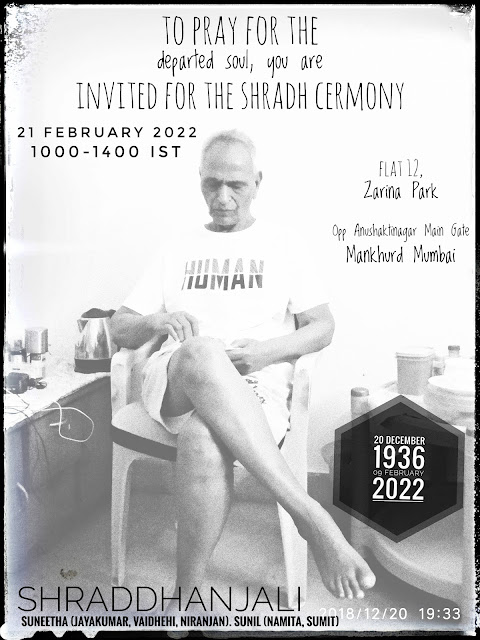
K S Rao (20 Dec 1936 - 09 Feb 2022)

Shraddanjali Invite

 K. S. Rao (20 Dec 1936 - 09 Feb 2022)

K S Rao to some, Chandrudu to some and Kopparapu Sudarsana Rao to some bid farewell at 0521 am IST on 09-Feb-2022 in Mumbai. We, Suneetha {Jayakumar, Vaidhehi, Niranjan} and Sunil {Namita, Sumit} are arranging a pooja (with the help of a pujari) on 21-Feb-2022 (13th day) between 1000-1400 hrs in Mumbai.
 
Though he did not show any inclinations towards any rituals, we believe  this might be the apt thing to do. The idea of the ritual (for those who believe) is to sincerely pray for the soul of the departed to journey to Yamapuri. It is believed, that the journey of the soul starts on the 13 th day and actually reaches Yamapuri on the 17 th day.  The rituals are expected to support this journey of the soul.
 
He lived a life on his own terms and was a person who was may be a couple of decades ahead of his time. He was a person who did not believe in fineness of communication. He did influence a lot of people in several different ways, be it as a colleague or a friend (all age groups). He was well read and took the ups and downs in life in the stride. 
 
If you have any memories, do leave a comment. 

A Lesson Hidden in Two Simple Words

Sometimes profound ideas are hidden in the most ordinary places. Recently, while looking at two common English words, I stumbled upon an int...